Bertie
Mariners' Museum, Uncurated Search Results
Type: Schooner
Year:
Builder:
Location:
These records are found in the online catalog of The Mariners’ Museum and Park in Newport News, Virginia. Uncurated search results are presented to give researchers and interested readers an idea of whether the museum’s archives contain information about this vessel and whether it may be worthwhile to visit the museum’s catalog search page for further investigation. Uncurated results may be inaccurate or incomplete.
Search mode: Exact Name. Search phrase(s): "Bertie". Results returned: 10. Results displayed in this table: 10.
Use these buttons to send uncurated search results to your own app or text document for further research. First, check the box for any row, or click "Select All" then uncheck any rows. Then click "Show Selections". You can then copy your selections from the text box and past them into your app.
| Fetch? | Row ID | Media | Date | Vessel | Place | Related Places | Inscription/Marks | Subject | Notes | Archive Number |
|---|---|---|---|---|---|---|---|---|---|---|
| 1 | No image URL. | Outer Banks (N.C.)–Fiction | "Facsimile reissue of Throop's first two novels." | LB5953 | ||||||
| 2 | No image URL. | facsims. | LB45020 | |||||||
| 3 | No image URL. | Bertie Biglow | P0001.011/01-0380 | |||||||
| 4 | 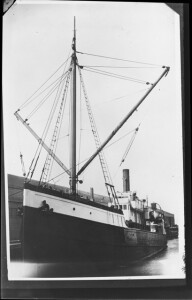 | 1883-1931 | "Bertie M. Hanlon" 1901 Ex "Marshfield" | Photograph of the vessel at dock. | MS0091/03.01-06#060 | |||||
| 5 | 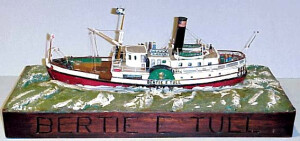 | NOTES: Plans for this model were by Eben Hearne, the donor. ADDITIONAL INFORMATION: See the article by Pete Lesher titled "Shipbuilding Powerhouse on the banks of the Pocomoke" published in Chesapeake Bay Maritime Museum's magazine Waterways, Summer 2007 NOTES: From the publication "E. James Tull, Shipbuilder on Maryland's Eastern Shore" by Pat Stille Martin: The Bertie E. Tull, built in 1895 at Tull’s shipyard, was a pioneer gasoline propelled sidewheel paddle steamer. The Bertie E. Tull, the first motor vessel on the Bay, was named for the shipbuilder’s oldest daughter and christened by E. James Tull’s niece, Anna. The Bertie E. Tull was 110 feet long and 35 feet wide and driven by a one-cylinder gasoline engine. From Christmas 1896 to April 1897, E. J. Tull drove the Bertie E. Tull passenger and freight boat to and from Cape Charles and Baltimore. From The Motor Boat: Devoted to All Types of Power Craft, Volume 7, edited by Francis P. Prial: The largest craft propelled by gasolene out of Baltimore is the Bertie E. Tull, 163 tons, and one of the most interesting of all the boats. The Tull, when launched in 1895, at Crisfield, Md., was the largest of her type that had even been built and the experiment of driving so large a craft with a gasolene motor of that date was regarded by the wiseacre as an impossibility. The owners of the Tull, however, had faith. They had her built as a sidewheeler and rigged up two 60 hp. stationary motors, one on each side, to drive the reversible bucket paddle wheels with which she was equipped. The Tull is 125.4 feet over all, 30 feet beam (from guard to guard), and 6.1 feet depth, so that, for 1895, she was no small craft...As a mechanical proposition the Tull was a success, but as a money-maker she was a failure. The cost of operation was too great, and she was finally laid up. VESSEL INFORMATION-- VESSEL NAME: BERTIE E. TULL VESSEL TYPE: Gasoline propelled paddle side-wheel motor vessel; After 1908, screw motor vessel SERVICE DATES: 1895 SHIP BUILDER: James E. Tull (designer and builder) BUILDER LOCATION: Maryland, Pocomoke City VESSEL HISTORY: The vessel was named for the shipbuilder's oldest daughter. VESSEL DIMENSIONS: 236 tons; 125.4' ALL SHIP NAMES: (1) BERTIE E. TULL (1895-1942); (2) DIXIE CRYSTAL (1943-1945). | CL14143 | |||||||
| 6 | No image URL. | Great Britain–Politics and government–1760-1789; United States–Politics and government–Revolution | Published anonymously. An answer to certain passages reflecting on the Earl of Abingdon's Thoughts on Mr. Burke's Letter to the sheriffs of Bristol. With: A letter from Edmund Burke ... to John Farr and John Harris, esqrs. sherrifs. 2d. ed. 1777. | LB38976 | ||||||
| 7 | No image URL. | Firearms–History; Firearms–Decoration | A history of firearms __ __by Major H. B. C. Pollard | LB36224 | ||||||
| 8 | No image URL. | United States–Politics and government–1775-1783. | With: A letter from Edmund Burke ... to John Farr and John Harris, esqrs. sherrifs. 2d. ed. 1777. | LB38975 | ||||||
| 9 | No image URL. | United States–Politics and government–Revolution; Great Britain–Politics and government–1777 | Bound with: Thoughts on the letter of Edmund Burke to the sheriffs of Bristol on the affairs of America. 2nd ed. [1777] ; Letter to the Right Honourable Willoughby Bertie by descent Earl of Abingdon ... In which His Lordship's candid and liberal treatment of the now Earl of Mansfield, is fully vindicated. 1778 ; Additional observations on the nature and value of civil liberty, and the war with America ... raising money by public loan ; an historical deduction and analysis of the national debt : and a brief account of the debts and resources of France. 1777. | LB38974 | ||||||
| 10 | No image URL. | SHORT DESCRIPTION: Black and white engraving showing a plan of the Royal Dockyard at Chatham. Drawn by Thomas Milton with the shipping engraved by John Clevely the Elder and the remainder by Pierre Charles Canot. Published by Thomas Milton. At the top is a view of shipping on the River Medway with the buildings of the dockyard in the background. At the bottom is a plan of the dockyard and part of Chatham Harbor (River Medway). There are twenty-five lettered references to the plan at the left edge in the center and twenty-five letter references to the elevation at the right edge in the center. A decorative border around the two images contains vignettes showing dockyard practices and naval maneuvers. Starting at the top center and working to the right around the edge they include 1) the first rate warship Royal Sovereign undergoing rigging and final construction, 2) a warship in a drydock with the text "sheathing in the dock", 3) a warship "giving chace", 4) a warship "foundering" (sinking), 5) a warship "wreck'd on the sands", 6) a warship in the process of losing its rigging with the text "Masts going by the Board", 7) a warship "jamb'd in between rocks", 8) a warship sailing with the text "Laying too under Ballanc'd Mizen", 9) a warship with men in the rigging with the text "boot topping". NOTES: The Yale Center for British Art notes: One of a series of views of the six Royal Dockyards, which were by the mid-eighteenth century the world's largest industrial complex and the state's biggest investment. These engravings present the dockyards as orderly, efficient, and rational; each makes reference to the specific functions of the dockyard represented, which depended in part on location. Chatham, on the Medway, was used as a strategic naval base during the Anglo-Dutch Wars of the seventeenth century. Sheerness, at the mouth of the Medway, was then built to take some of the pressure off Chatham, so that ships needing minor repairs did not have to travel the length of the river. Thereafter fleets moored at Chatham during the winter or while on reserve, and the dockyard became employed in repairs more than shipbuilding. Accordingly, the vignettes bordering this print display a combination of dockyard practice (“Sheathing in the dock”), maneuvers (“Laying to under balanc’d mizzen”), and disasters (“Jamb’d in between rocks,” “Wreck’d on the sands”). | CL10979 |
Created 2026 by Don Barker, CBMM volunteer, for the Chesapeake Shipbuilding Project. shipbuilding@sailingworkboats.es